Allergies and Insects

Bee AllergenInsects can cause an allergic reaction in people. Generally speaking, one mechanism is through a food consumption, secondly is through environmental exposure.

What does the FDA think about food allergens?

The FDA’s primary concern with regard to food allergens are the ‘Big 8’. They are Milk, Eggs, Fish, Crustacean shellfish, Tree nuts, Peanuts, Wheat and, Soybeans. These foods account for over 90% of food allergic reactions. There are over 160 foods that can cause allergies but these 8 are the only ones that require labeling by law. People allergic the shells may see cross reactivity to insects. The prevalence of shellfish allergy in the United States is around 2%. The majority of the population can consume insects without significant risk of an allergic reaction. I do recommend voluntary allergen labeling for packaged insect products. Consumer education will help general acceptance of insects as food.

Environmental insect matter can cause allergy symptoms. Skin contact and dust inhalation can have adverse effects on people farming and post-harvest processing of insects. Fecal matter and dried insect parts can become airborne and subsequently be inhaled. Sensitization can occur from repeat exposure. Issues with worker related environmental allergens would involve the Occupational Safety and Health Administration (OSHA). I am curious to know if insect farmers that currently produce high volumes have come across this issue.

What should we do about insect allergens?

  • Regularly clean farming facilities including the farming equipment and other building surfaces to remove dust and particulate matter.
  • Monitor the health of insect farmers for development of allergic sensitization. Use personal protective equipment such as mask and googles when appropriate.
  • Limit dispersal of fine particulates when making insect flour through engineering controls.
  • Label insect containing food products with an allergen statement such as ‘People allergic to shell fish may also be allergic to insects’.
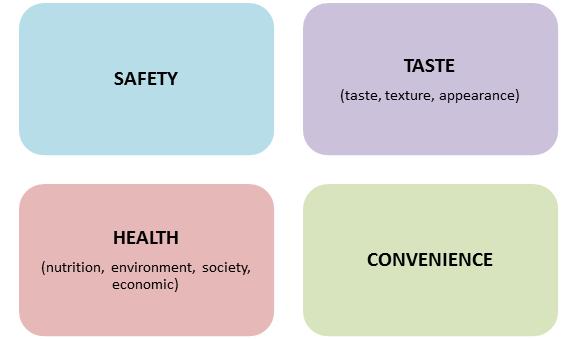
Four Quality Factors of Food

Quality Factors

Safety, convenience, taste and health are intrinsic quality factors that affect food choices. Let’s take a closer look at these factors and see how edible insects score.

Safety – Unglamorous but the most important factor. Safety hazard examples include pathogens (E. coli), heavy metals (mercury) and pesticide residues. If a food product doesn’t meet basic safety requirements, it won’t ever make it into your kitchen. When comparing food choices, safety is not a point of differentiation because most safety risks have been eliminated for the consumer by using good manufacturing practices and processing. Wild harvested insects are not recommended for consumption because there is a risk that they may have picked up pesticide residue along their travels.

Convenience – Often taken for granted, convenience varies widely.

Not convenient: dry chick peas

Convenient: canned chick peas

Very convenient: prepared hummus

When it comes to edible insects, processing live insects can be quite a handful for the chef. Raising your own insects takes devotion. Providing minimally processed and processed insects is a possible opportunity to gain further acceptance of edible insects

Taste – This is the space where most of the competition takes place. After all, taste is king. If someone doesn’t like the taste of a food, they are not going to eat it again. Taste is usually a tradeoff between other factors. Canned crickets are more convenient than frozen but the taste and texture is probably better in frozen crickets. Crickets are visually striking which does not earn them any points. People generally don’t like the idea of an insect looking back at you when you are about to eat it. Turning crickets into a flour is an excellent way to by-pass this issue. If poached or fried insects are being prepared… chop them up.

Health – Based on large food company behavior, health only has one category, nutrition. America’s food system is not doing an adequate job addressing socio-economic costs. Brands are quick to tell you how much fiber is in their product but they don’t tell you if it’s GMO fiber or if it’s highly processed fiber. It doesn’t help that individual consumers are not aware that their food choices also have far reaching environmental, social and economic influences. Health is why people should stop eating feed lot beef. Insects get 5 stars for health.

Are insects ready for the masses?

Even though people who practice entomophagy feel that insects are safe to eat, the average person may not be so confident. When communicating about edible insects, safety should be addressed by stating that insects, that are produced using GMPs, are safe to eat. Safety will probably become a non-issue as people become aware that insects are tasty and good for you. Taste and convenience is where our food system does an excellent job at creating craveable and easy to prepare food. Just about every store sells cold soda. There is tremendous opportunity for innovation in these area. Insects can be prepared in a variety of ways and different species offer unique tastes and textures. Literature often sites that insects taste excellent and are considered delicacies. We just have to find the right presentation for the American palate. For health, the preferred way to raise insects is through regional farming operations. We need to be mindful when sourcing insects so that they are not raised on chicken meal and preferably not sourced internationally. I think insects are ready.

Are Insects Safe to Eat

Generally Recognized As Safe (GRAS) is a food substance designation put forth by the FDA. GRAS substances can be used in food under specified conditions as long as the safety of the substance can be validated.

There are two paths to achieve GRAS status. One is through scientific procedures with data being generally available. The second path, for a substance used in food before 1958, is through experience based on common use in food. This is kind of vague but check out this link:

FDA GRAS Page

Do insects meet GRAS requirements? Insects have been consumed for food throughout human history. There are also experts in the science community that promote the wholesomeness of insects as food. There are no known hazards associated with consuming insects except for allergies. Domestically farming insects using good manufacturing practices will reduce or eliminate the risk of common hazards such as pesticide residue.

I do not agree with Edible insects: future prospects for food and feed security’s interpretation that insects are additives. Insects used in food are GRAS and therefore do not default to a food additive status. Additives require premarket approval.

Commonly consumed edible insect in the US such as meal worms, crickets and wax worms should be considered GRAS.

FDA approval of GRAS substances is not required before using them in food. There is a GRAS notification program to notify the FDA of a substance but it is not necessary. The program either confirms your determination or disagrees.

Article: Is the GRAS Process Broken?

Federal Regulation Regarding Edible Insects

legeal scales from Avery

USDA or FDA

On a federal level, my understanding is that edible insects are not regulated by the Food and Safety Inspection Service (FSIS) of the USDA. FSIS is what we typically think of when associated the USDA with food. The FSIS covers meat, poultry and eggs. I didn’t see anything that remotely relates to insects with regard to FSIS responsibilities. Everything else is under FDA regulations. FDA regulates sea food (which is most similar to insects …think shrimp and soft shell crab) and even covers game such as venison. “What does FDA regulate” link: fda.gov/aboutfda/transparency/basics/ucm194879.htm

The USDA may be involved in insect farming through their Animal and Plant Health Inspection Service (APHIS) agency. For example, if you want to import a new species that is not currently in the US, you would need to contact APHIS. It is my understanding that current insect for feed farms don’t really interact with APHIS but I just might be unaware.

State and local regulations is another can of worms. Ideally, federal agencies responsible for food safety and security will provide leadership to state and local authorities.